

Success Stories
From a Training Catalog to an Adaptive Skills Ecosystem.
Sumo Logic
A fast-growing company needed its training to keep up.
Sumo Logic’s internal professional development was effective but informal — a catalog of training without a shared structure, and no way for employees to carry proof of what they’d learned. As the company scaled, that gap became a real cost.
MCM partnered with Sumo Logic across two connected phases — first building a verifiable credentialing ecosystem, then developing the instructional strategy that gave it real substance — turning ad hoc training into a structured, skills-based program employees could own.
By the Numbers
A program built on real structure.
Sumo Logic’s learning strategy moved beyond a training catalog and into a structured, skills-based ecosystem designed to support role clarity, onboarding, and growth.
Skills-based micro-credentials developed
Individual skills represented
Core role pathways built out
Structured onboarding window
What those numbers represent
The work connected two phases into one usable operating model: first the credentialing ecosystem, then the instructional strategy that turned it into a practical onboarding and skills-development experience.
How It Came Together
One project. Two connected phases.
The goal was not just to launch credentials. It was to help Sumo Logic turn internal professional development into a structured, skills-based ecosystem employees could understand, use, and grow with.
Project Arc
Phase one built the credentialing foundation. Phase two translated that foundation into an instructional strategy that made the ecosystem clearer, more reusable, and more scalable.
From training catalog to credentialing platform.
Discovery with the Sumo Logic team
Created a shared understanding of needs, constraints, and success criteria so the build reflected the real operating context.
Vendor evaluation and selection
Helped Sumo Logic choose a right-fit platform at the time, reinforcing MCM’s vendor-neutral approach and reducing unnecessary guesswork.
MVP ecosystem configuration
Turned the idea into a working environment the team could actually see, test, and refine instead of discussing in the abstract.
Credential buildout and admin training
Gave Sumo Logic a usable first system — 14 micro-credentials, 33 skills, and an internal team better prepared to manage the work.
From credentials to a real instructional model.
Interviews and light system audit
Surfaced how professional development was actually functioning, giving the strategy a clearer foundation and making the next decisions more credible.
Reusable curriculum schema
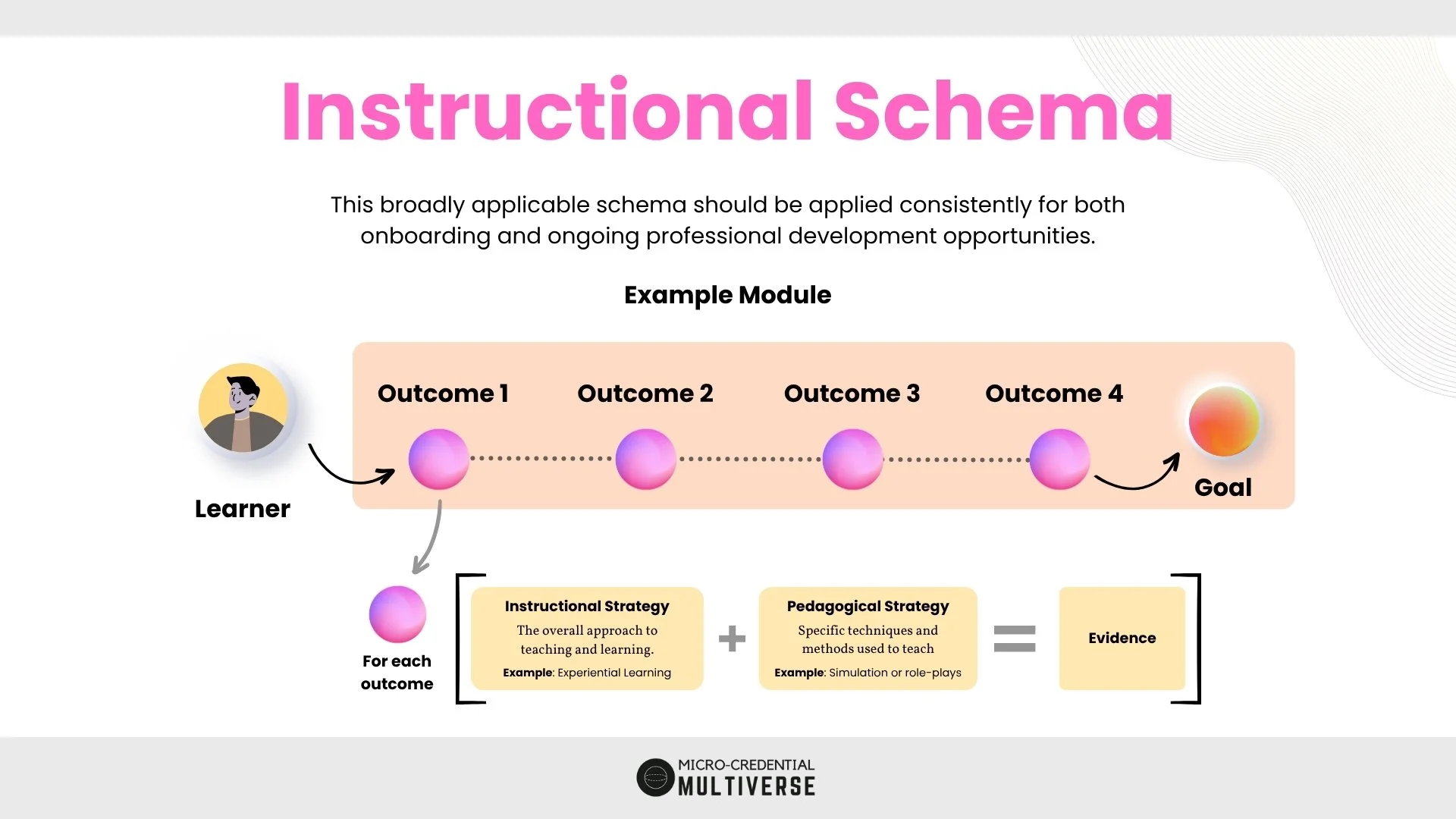
Introduced a consistent structure — Goal, Outcome, Strategy, Evidence — so learning could be repeated, improved, and assessed more reliably.
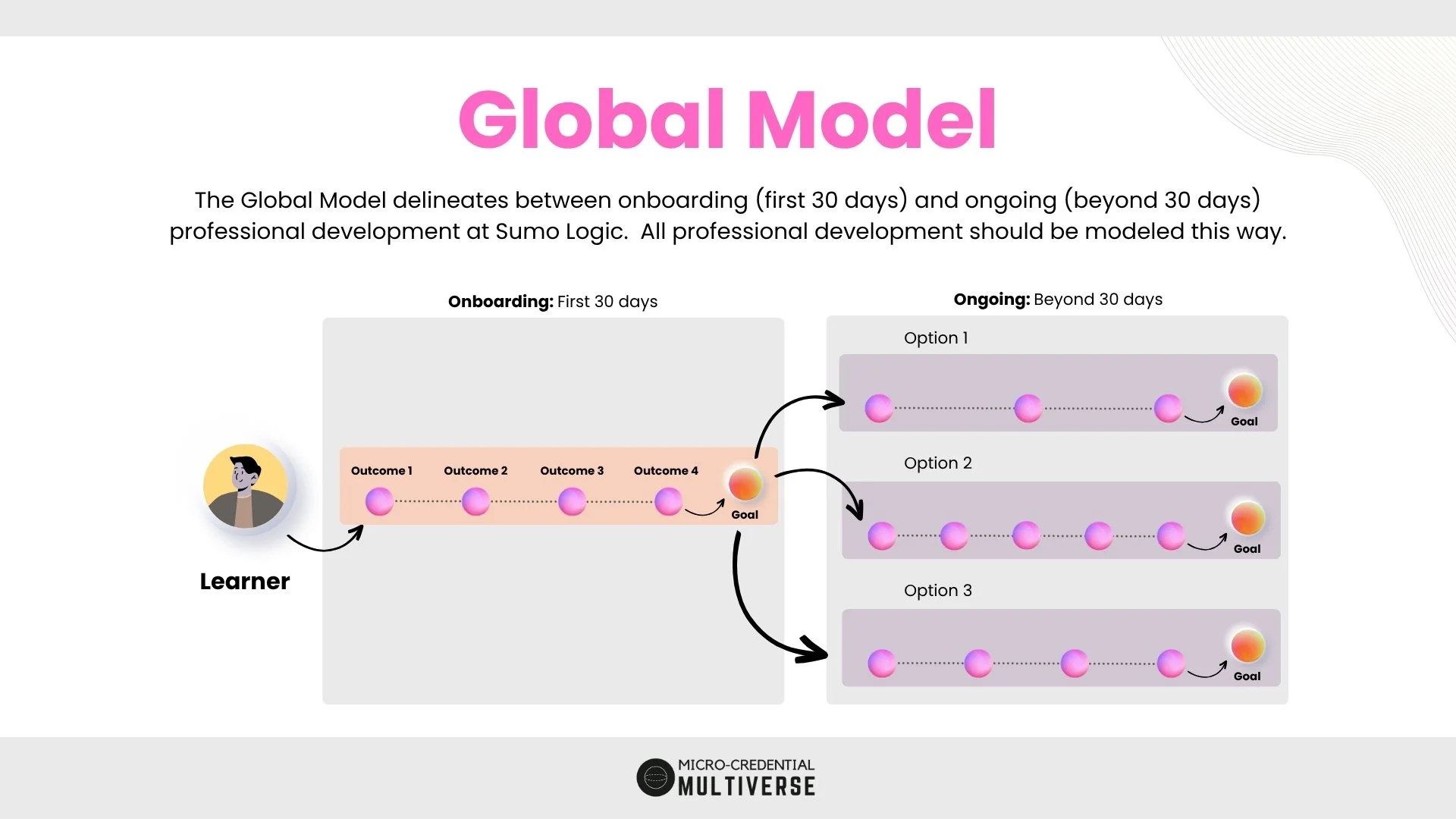
Onboarding and ongoing development model
Created a better fit between early onboarding and longer-term growth, helping employees receive the right support at the right stage.
Role examples, review cadence, and KPIs
Made the strategy more usable across teams by connecting it to real roles, clearer expectations, and a way to monitor progress over time.


The First 30 Days
Role-specific onboarding, tied to outcomes from day one.
Sumo Logic needed onboarding that did more than confirm training completion. The first-30-days model focused each new employee on role-specific capabilities, defined learning outcomes, and evidence that could support KPI evaluation.
From compliance to capability
The schema helped Sumo Logic ask a better question: not “Did someone complete the training?” but “What skills and capabilities did they build, and how can they show it?”Role-specific
Alignment of onboarding modules with role expectations to maximize early success and retention.Outcome-based
Defined outcomes that made progress easier to reach, teach, and evaluate.Evidence-backed
Learning tied to proof of capability, not just attendance or completion.Ongoing Professional Development
Beyond 30 days, learning becomes cross-cutting and collaborative.
After onboarding, the model shifts from role-specific readiness to broader capability development. The key insight was that Account Executives, Systems Engineers, and Sales Development Representatives collaborated frequently — so the learning model needed to support blended outcomes, mentorship, and shared growth across teams.
The strategic shift
The first 30 days focused on role-specific skills tied to outcomes and KPI evaluation. Beyond 30 days, learning became more blended — reflecting how work actually happened across teams.Roles analyzed
Cross-cutting
Learning goals could extend across roles instead of staying locked inside one job function.Mentorship-based
Ongoing development could draw on peer learning, coaching, and shared expertise.Collaborative
Employees could build capabilities together in ways that created value for individuals and Sumo Logic.
Built for Real Roles
The schema, applied to the work people actually do.
The model was built and tested against three core go-to-market roles, demonstrating how the same structure supports role-specific onboarding, cross-functional collaboration, and ongoing skills growth.
Turning relationship work into demonstrable sales capability.
Account Executives sit closest to the customer relationship. Their development pathway needed to strengthen the work that drives revenue: identifying opportunities, shaping sales conversations, negotiating effectively, and communicating Sumo Logic’s value with confidence.
Role story
Client relationships → sales strategy → negotiation → customer valueKey skills
Crossover value
Better collaboration with Systems Engineers helps AEs translate technical product knowledge into clearer value for customers.Connecting technical expertise to customer-facing outcomes.
Systems Engineers needed development experiences that respected the complexity of their technical work while making that expertise easier to apply in the sales motion. Their pathway emphasized technical design, troubleshooting, problem-solving, communication, and collaboration across teams.
Role story
Technical design → troubleshooting → collaboration → solution fitKey skills
Crossover value
Working closely with Account Executives and Sales Development Representatives helps SEs connect customer needs to practical, technically sound solutions.Building the bridge from early qualification to stronger sales conversations.
Sales Development Representatives are often the first signal in the sales process. Their pathway needed to support early opportunity identification, stronger qualification, better meeting setup, and more informed handoffs to Account Executives and Systems Engineers.
Role story
Lead generation → qualification → meeting setup → better handoffKey skills
Crossover value
Stronger SDR development helps customers reach the right Account Executive or Systems Engineer with clearer context and better fit.Built to Last
Credentials people could actually trust — and carry with them.
A credential only matters if it can be trusted outside the system that issued it. Every micro-credential built for Sumo Logic was designed to be independently verifiable — not just a static certificate, but a digital record that could be checked and trusted on its own.
Vendor-neutral by design
MCM evaluated and selected the credentialing technology that fit Sumo Logic’s specific needs at the time. MCM does not sell or favor any single platform — the right tool is chosen for the client, not the other way around.
Independently verifiable
Credentials could be checked without relying only on Sumo Logic’s internal systems.Evidence-connected
Recognition pointed back to skills, outcomes, and the learning experience behind the award.Built for handoff
The ecosystem was configured so Sumo Logic’s team could operate it independently.Ready to Build What Comes Next?
Turn your training catalog into a real skills strategy.
Micro-credential Multiverse helps L&D teams design skills-based credentialing programs that are structured, verifiable, and built to grow with the organization.
Start a conversation